Structure of the standard
EN 1090 is divided into parts with different roles. The editions have been revised several times, so you should always check the one referred to in the contract or in the design.
- EN 1090-1: requirements for conformity assessment of structural components, that is factory production control and CE marking
- EN 1090-2: technical requirements for the execution of steel structures, from material preparation to welding, bolting, inspection, tolerances and erection
- EN 1090-3: technical requirements for aluminium structures
CE marking and factory production control
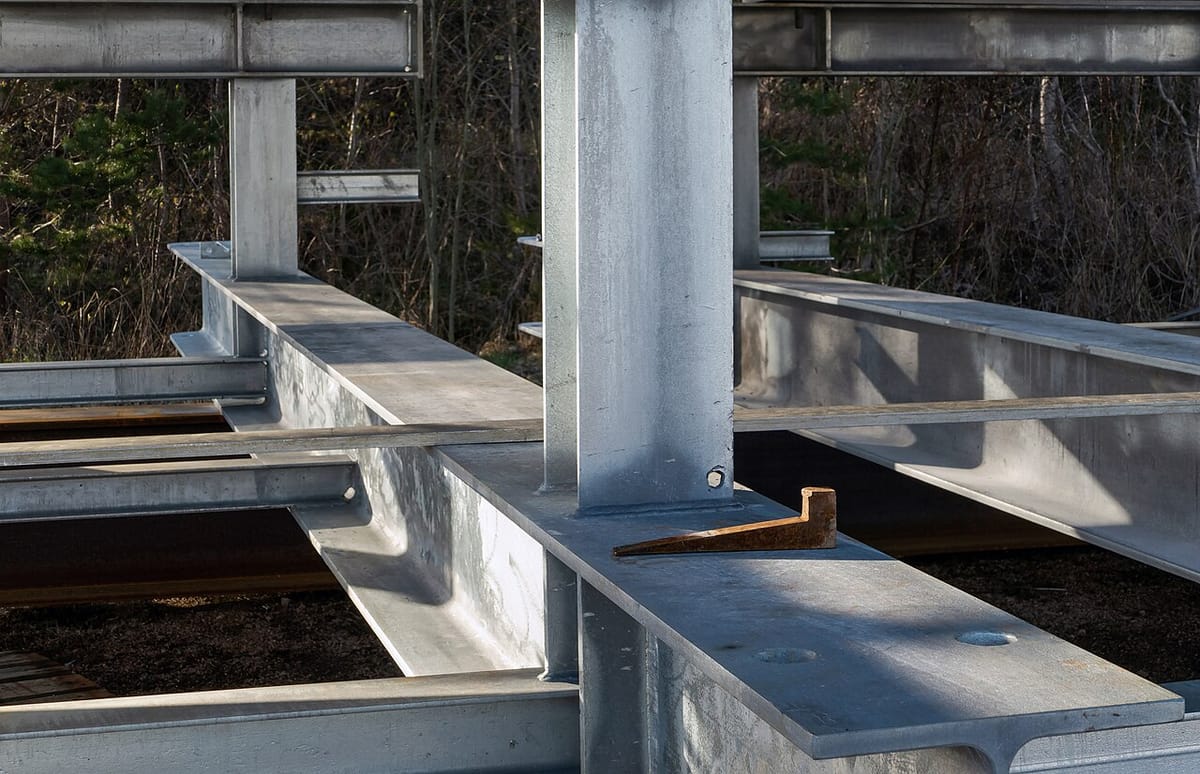
EN 1090-1 is a harmonised standard under the European Construction Products Regulation. A company that fabricates structural steel components for construction works must have a factory production control system, called FPC, certified by a notified body, and must draw up the declaration of performance.
The FPC describes how the company manages materials, procedures, equipment, personnel, traceability and inspections. Where welding is involved, the certificate also states the highest execution class for which the company is qualified.
Execution classes EXC1–EXC4
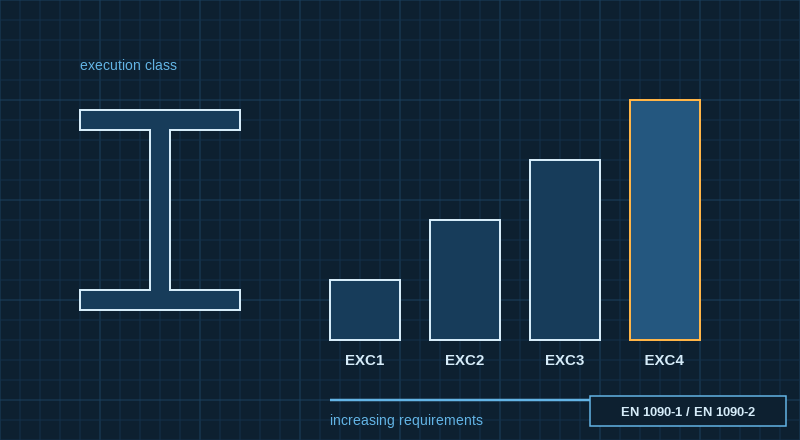
EN 1090-2 provides four execution classes, from EXC1, the least demanding, to EXC4, the most demanding. Each class sets a group of requirements: qualification of welding procedures, competence level of the coordinator, extent of non-destructive testing, traceability of materials.
The class is not chosen by the fabricator: it is specified by the structural designer. For steel structures the selection method is given in Eurocode 3, based on the consequence class, that is the consequences of a failure, and on the type of loading, static or fatigue. EXC2 is the most common class for ordinary buildings.
Welding, quality levels and tolerances
For welded structures EN 1090-2 requires a welding quality system to EN ISO 3834, with the applicable part increasing with the class. You need a welding coordinator with technical knowledge appropriate to the class, as set out in EN ISO 14731, welders qualified to EN ISO 9606-1 and procedures qualified to the EN ISO 15614 series or equivalent permitted methods.
Quality levels for imperfections refer to EN ISO 5817. As a general rule EXC1 requires level D, EXC2 level C, EXC3 level B and EXC4 level B with additional requirements; however, the standard provides exceptions for certain types of imperfection.
For geometrical tolerances the standard distinguishes essential tolerances, which are needed for the resistance and stability of the structure, from functional tolerances, related to appearance and fit-up, divided into two classes.
Machine frames and fabrications
A machine frame is not a construction product, so CE marking to EN 1090-1 usually does not apply: the machine follows its own directive. EN 1090-2 nevertheless remains a widely used reference for clearly setting out the fabrication requirements of welded fabrications for machinery and equipment.
Ranieri — Servizi di ingegneria helps you choose the EN 1090-2 execution class for machine frames and fabrications and transfer the requirements to the drawings, but does not certify the FPC and does not set the class for building structures, which is the responsibility of the licensed designer of the works.
Frequently asked questions
Who decides the execution class?
It is set by the structural designer, following the Eurocode 3 method and taking into account the consequences of a failure and the type of loading. The fabricator must be certified for the same class or a higher one.
Is EN 1090 mandatory?
CE marking to EN 1090-1 is mandatory for structural steel and aluminium components placed on the market for construction works. For other products, such as machine frames, EN 1090-2 applies only if referred to in a contract or specification.
What do you need to obtain EN 1090 certification?
A documented factory production control system, qualified welding personnel and procedures, a welding coordinator and an assessment by a notified body, which issues the FPC certificate.
What is the difference between EN 1090-1 and EN 1090-2?
Part 1 deals with conformity assessment and CE marking. Part 2 contains the technical execution requirements: welding, bolting, inspection, tolerances and erection.
Summary for information only: the requirements are those of the official text of the standard in its current edition, available from the standards bodies. Ranieri — Servizi di ingegneria covers the mechanical side and does not carry out work reserved to members of a professional register.