
Scope
The standard applies to permanent means of access that are part of the machine, including those fixed to supporting structures. It does not cover portable ladders or building access, which follow other rules.
The starting principle comes from EN ISO 12100: where possible, the machine is designed so that operations can be carried out from ground level. A means of access comes into play when this is not possible.
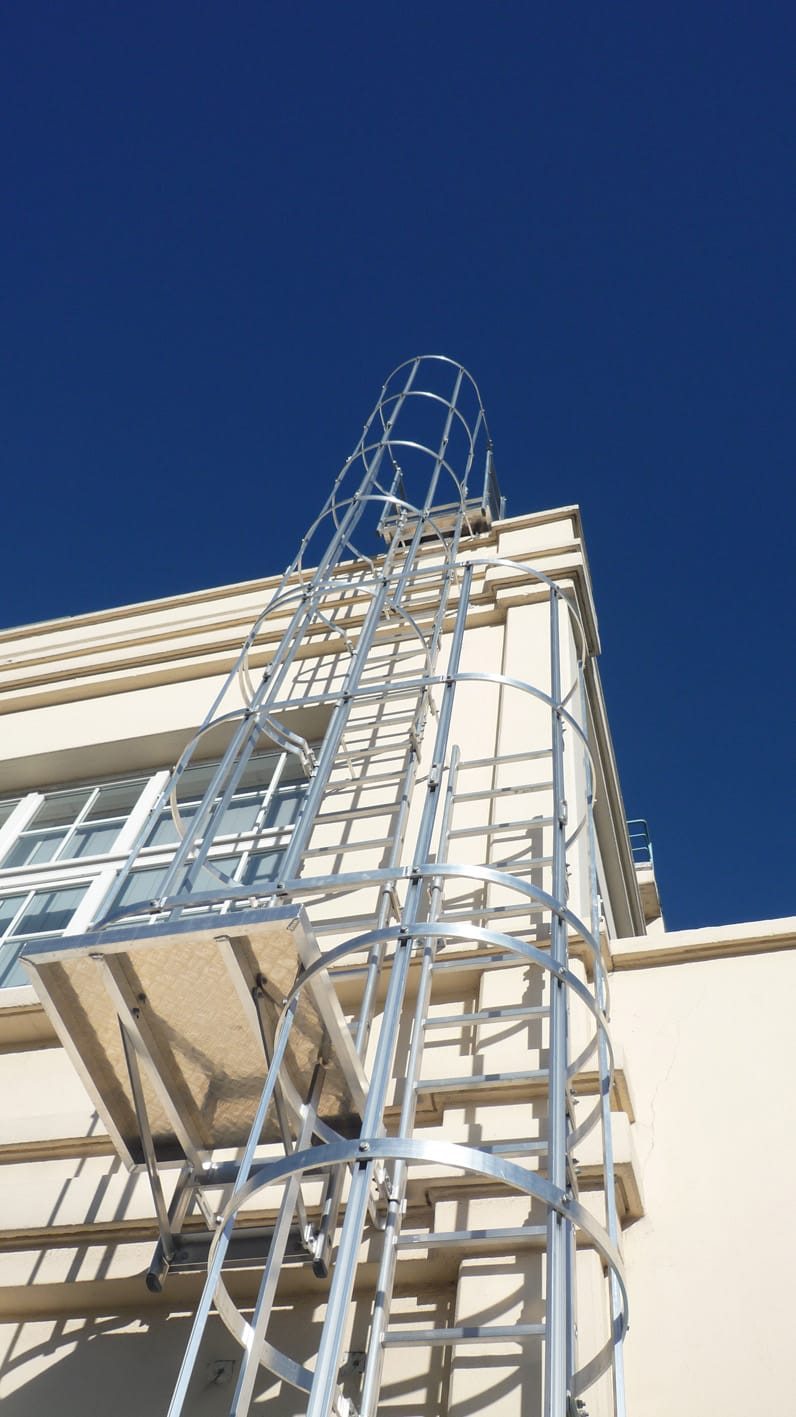
The four parts
- Part 1: choice of fixed means of access and general requirements.
- Part 2: working platforms and walkways, with requirements on dimensions, flooring and strength.
- Part 3: stairs, stepladders and guard-rails, with step geometry and requirements on handrails, toe-boards and guard-rail strength.
- Part 4: fixed ladders, i.e. rung ladders, with requirements on rungs, stiles, exits and fall protection.
How to choose the means of access
Part 1 links the choice to the angle of climb and to the use. In order of preference: direct access from the floor level, ramp, stairs, stepladder and, as a last resort, the fixed rung ladder.
As a guide, ramps cover the lowest slopes, up to 20°, stairs the range from 20° to 45°, stepladders from 45° to 75° and fixed ladders from 75° to 90°. The frequency of access, the carrying of tools or materials, the number of people and any need for rapid evacuation also matter.
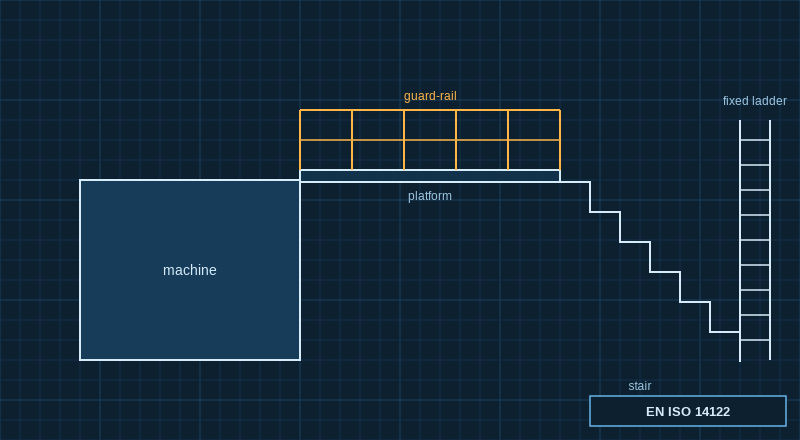
Main requirements to check
The standard sets geometric and strength requirements. The exact values must be read in the edition you are applying; some are very well known, such as the minimum guard-rail height of 1100 mm, the toe-board of at least 100 mm and the maximum clear gap of 500 mm between handrail and knee-rail or between knee-rail and toe-board.
- Platforms and walkways: clear width, clear height above the walking surface, floor openings, slip-resistant surface and deflection under load.
- Stairs: ratio between rise and going, uniformity of the steps along the flight, width, intermediate landings and handrails.
- Guard-rails: when they are needed depending on the fall height and the distance from the edge, make-up with handrail, knee-rail and toe-board, test loads.
- Fixed ladders: rung spacing, width between stiles, exit at the top, fall protection with a safety cage or fall arrest system above a certain height.
Documents and common mistakes
In the technical file it is advisable to have dimensioned drawings of the means of access, a check of the dimensions against the standard and a structural check of decks, steps and guard-rails under the required loads. The studio can check the walkways, stairs and guard-rails of a machine to EN ISO 14122 and recommend corrective actions.
The most common mistakes are guard-rails interrupted at gates or openings, a first step with a different rise from the others, missing toe-boards on open sides, rung ladders used where stairs would be possible, and gratings with openings that are too wide above walkways.
Related standards
The series is used together with EN ISO 12100 for risk assessment, EN ISO 13857 for safety distances from danger zones and the type-C standards for the specific machine, which may contain specific requirements on means of access.
Frequently asked questions
What is the minimum guard-rail height according to EN ISO 14122-3?
The minimum height of the guard-rail handrail is 1100 mm, measured from the walking surface. The guard-rail also includes a knee-rail and a toe-board.
When does a platform need a guard-rail?
It depends on the fall height and on the distance between the edge and the working area. Part 3 indicates the conditions in which a guard-rail is mandatory and those in which simpler protection is enough.
Stairs or stepladder: how do I choose?
The choice depends on the available angle and on the use. Stairs are preferable because they can be used more safely, especially when carrying tools; a stepladder is used when space requires steeper slopes.
Does EN ISO 14122 apply to stairs in buildings?
No. It covers the means of access that are part of the machine. Access in buildings and workplaces follows building standards and occupational health and safety legislation.
Summary for information only: the requirements are those of the official text of the standard in its current edition, available from the standards bodies. Ranieri — Servizi di ingegneria covers the mechanical side and does not carry out work reserved to members of a professional register.