
Structure of the series
The series is divided into parts. The first two are the ones you use most often at the design stage.
- Part 1: inside diameters, cross-sections, tolerances and designation codes
- Part 2: housing dimensions for general applications
- Part 3: quality acceptance criteria, i.e. the permitted surface imperfections
- Part 4: anti-extrusion rings (back-up rings)
- Part 5: suitability of elastomeric materials for industrial applications
Part 1: sizes and tolerances
Part 1 lists the standardised combinations of inside diameter and cross-section. The most commonly used cross-sections include 1.78, 2.62, 3.53, 5.33 and 6.99 mm, compatible with the inch series widely available on the market. Tolerances depend on the class chosen, tighter for critical applications and wider for general ones.
The designation code gives the reference to the standard, the inside diameter, the cross-section, the tolerance class and the quality grade. Using it on drawings avoids ambiguity with suppliers.
Part 2: housings
Part 2 gives the groove dimensions for each cross-section and for the typical cases: radial sealing on a piston or rod, static or dynamic, and axial sealing with pressure from inside or outside. For each case it specifies groove depth and width, fillet radii, lead-in chamfers and surface finish.
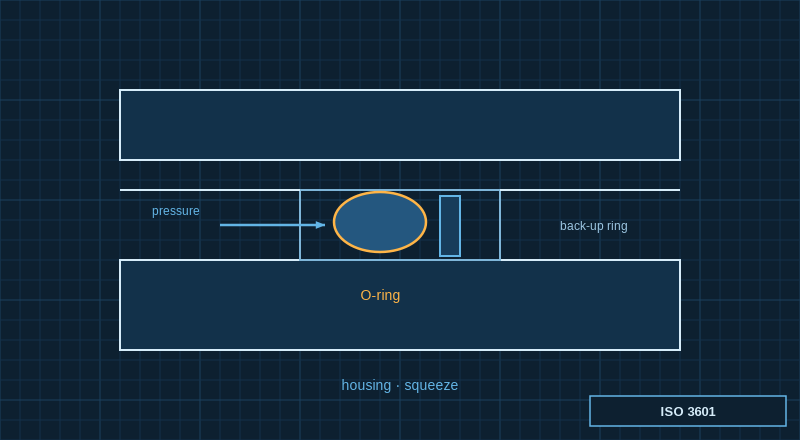
The dimensions are designed to achieve three results at once: enough squeeze to seal even at low pressure, free volume in the groove for thermal expansion and swelling of the elastomer, and an extrusion gap compatible with the pressure.
The checks to carry out
If you depart from the standard housings, or want to check a borderline case, work with the actual tolerances and not with the nominal values:
- Squeeze: the percentage reduction of the cross-section in the groove. It must be checked with the worst-case tolerance combinations. Dynamic seals work with lower values than static seals to limit friction and wear.
- Gland fill: the ratio between the volume of the ring and that of the groove. A margin must remain for thermal expansion and swelling in the fluid, otherwise the ring is forced into the gap.
- Circumferential stretch or compression: a ring fitted under high stretch loses cross-section and therefore squeeze.
- Extrusion gap: it depends on the tolerances of the parts and on the deformation under pressure. Together with pressure and hardness, it determines whether anti-extrusion rings are needed.
Anti-extrusion rings and compound selection
Anti-extrusion rings, covered in Part 4, are fitted on the low-pressure side, or on both sides if the pressure reverses. They require a wider groove, which Part 2 provides for.
The compound is selected according to fluid, temperature, pressure and type of motion. As a general rule, NBR is suitable for mineral oils, FKM withstands higher temperatures and many aggressive fluids, EPDM is suitable for water, steam and glycol-based fluids but not for mineral oils, and silicone works well in the cold but has poor mechanical strength. The most common hardness is around 70 Shore A, with harder compounds for high pressures. Always check compatibility in the compound manufacturer's tables.
Common mistakes and related standards
The most common mistakes are calculating squeeze on nominal values only, forgetting swelling in the fluid, fitting the ring over sharp edges or threads without a lead-in chamfer and choosing the compound on temperature alone. Our studio can size and check O-ring housings to ISO 3601 with the actual tolerances of the parts.
Related standards: ISO 286 for diameter tolerances, ISO 21920 for surface roughness, ISO 1629 for elastomer designations. Many catalogues also list the American AS568 series, with largely corresponding sizes.
Frequently asked questions
What is the difference between ISO 3601 and AS568?
AS568 is the American inch series. Many ISO 3601-1 sizes coincide, but tolerances, classes and designations follow their own rules: always state which standard you are referring to.
How much squeeze should an O-ring have?
It depends on the type of seal: static or dynamic, radial or axial. The ISO 3601-2 housings are already calculated for correct values: if you change the dimensions, check the squeeze with the worst-case tolerances.
When are anti-extrusion rings needed?
When the combination of pressure, radial gap and elastomer hardness risks pushing the ring into the gap. They are also needed with pulsating or alternating pressures.
Can I use an O-ring in a non-standard groove?
Yes, if you check squeeze, gland fill, stretch and extrusion gap. Standard housings, however, simplify procurement and reduce the risk of errors.
Summary for information only: the requirements are those of the official text of the standard in its current edition, available from the standards bodies. Ranieri — Servizi di ingegneria covers the mechanical side and does not carry out work reserved to members of a professional register.