Scope
The standard covers industrial metallic piping and its components: straight pipes, bends, reducers, tees, flanges, end caps and supports. It does not apply to piping that has its own product standards, such as long-distance transmission pipelines or gas distribution networks, and it does not replace the standards for the equipment the line is connected to.
Structure of the standard
The series is divided into parts that are read together. The edition and amendments in force change over time: always check the version cited in the contract or in the PED documentation.
- Part 1: general, definitions and organisation of the series
- Part 2: permitted metallic materials and their requirements
- Part 3: design and calculation
- Part 4: fabrication and installation
- Part 5: inspection and testing
- Part 6: additional requirements for buried piping
- Part 7: guidance on the use of conformity assessment procedures, published as a technical report
- Part 8: additional requirements for aluminium and aluminium alloy piping
What Part 3 requires
The first step is the wall thickness for internal pressure. For a straight pipe, the formula relates the minimum thickness to the calculation pressure, the diameter, the design stress of the material at the calculation temperature and the weld joint efficiency factor. The corrosion allowance and the negative manufacturing tolerance of the pipe are added to the minimum thickness.
Then come the rules for components: bends, taking into account thinning at the extrados; branch connections, with reinforcement of the removed area; reducers, end caps and flanges.
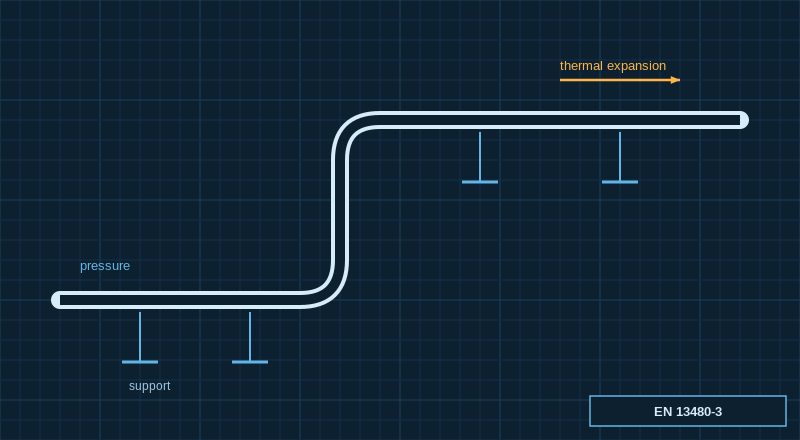
The most demanding part is the flexibility analysis. The line must be checked for sustained loads, such as pressure and weights, for occasional loads, such as wind, earthquake or water hammer, and for the stress range due to thermal expansion. The calculation also gives the reactions on the supports and the forces and moments on the nozzles of pumps, vessels and heat exchangers.
Finally, the standard deals with the design of supports: guides, anchors, spring hangers and constant-load supports, with their spacing and design loads. A fatigue assessment is required for cyclic services.
Data and documents to prepare
- Isometric drawings or a 3D model of the line with dimensions, support locations and type of restraint
- Fluid, design and operating pressure and temperature, with significant transients
- Materials, diameters, nominal wall thicknesses, corrosion allowance
- Piping class with flanges, fittings and gaskets
- Allowable nozzle loads on the connected machines
- PED category of the line and chosen conformity assessment module
Relationship with the Pressure Equipment Directive 2014/68/EU
Piping is pressure equipment under Directive 2014/68/EU. The category depends on the fluid group, the physical state, the maximum allowable pressure PS and the nominal size DN. Below the thresholds, sound engineering practice applies, without CE marking.
The harmonised parts of EN 13480 give a presumption of conformity with the essential requirements they cover. They are not mandatory: you can use another method, but you must then demonstrate conformity in another way. Conformity assessment and marking are the manufacturer's responsibility, with the involvement of a notified body where required.
Common mistakes and related standards
The most common mistakes are forgetting the negative wall thickness tolerance, over-restraining a hot line, neglecting nozzle loads and using allowable stresses taken from a code other than the one declared. Our studio can check the wall thicknesses and flexibility of a line to EN 13480-3 and prepare the calculation report for the manufacturer.
Standards often used alongside it: EN 1092-1 for flanges, EN 10216 and EN 10217 for steel tubes, EN 13445 for unfired pressure vessels, EN ISO 15614-1 for welding procedure qualification.
Frequently asked questions
Is EN 13480 mandatory?
No. It is a voluntary standard. Its harmonised parts give a presumption of conformity with the PED, but you can use another code if you demonstrate compliance with the essential requirements in another way.
What is the difference between EN 13480 and ASME B31.3?
They are two different piping codes. Allowable stresses, load combinations and inspection requirements differ. Mixing them is not advisable: choose one code and apply it consistently to the whole line.
When is a flexibility analysis needed?
When the line operates at temperatures different from the installation temperature, is connected to load-sensitive machines or is subject to frequent cycles. For cold, short and simple lines the standard allows simplified checks.
Does piping below the PED thresholds follow EN 13480?
It is not required to, but the standard remains a useful reference for demonstrating the sound engineering practice the directive requires for those lines.
Summary for information only: the requirements are those of the official text of the standard in its current edition, available from the standards bodies. Ranieri — Servizi di ingegneria covers the mechanical side and does not carry out work reserved to members of a professional register.