
Scope
The standard covers non-powered axles with journals and axle boxes outside the wheels, the most common case on wagons, coaches and many special vehicles. Powered axles, which also carry gears and transmit traction torque, are covered by EN 13104. Axles with inboard axle boxes have a dedicated part of the same series.
EN 13103-1 results from the revision of the previous EN 13103: if you are working with older documents, check which edition they refer to.
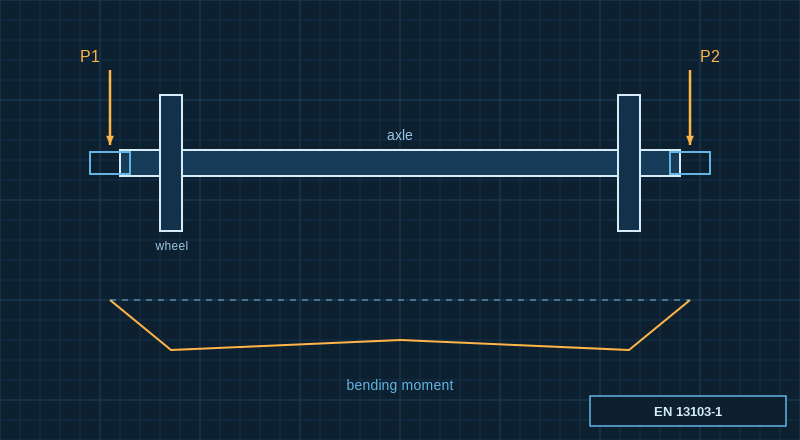
The method: forces and moments
The calculation starts from the masses acting on the axle and the geometry of the wheelset: position of the journals, the wheels and any brake discs. The standard prescribes how to derive the vertical, lateral and longitudinal forces acting during running, with factors that take account of dynamic effects, curves and track.
To these are added the effects of braking, which depend on the system adopted: brake blocks on the wheels or discs mounted on the axle. From all the forces you obtain the distribution of bending and torsional moments along the axle, combined according to the rules of the standard.
Stresses in the sections and permissible stresses
For each significant section the stress is calculated from the resultant moment and the diameter. At changes of diameter, transition radii and press-fit seats the stress is increased by stress concentration factors that depend on the geometry, taken from the diagrams in the standard.
The stresses obtained in this way are compared with the permissible stresses, which depend on the steel grade, the zone of the axle and a safety factor. The press-fit zones have lower limits than the axle body, because contact with the hub reduces fatigue strength. The method is conventional: it is calibrated on service experience and does not require a finite element analysis.
Link with EN 13104 and EN 13261
- EN 13104: same approach for powered axles, with the effects of the transmission in addition
- EN 13261: product requirements for the axle, i.e. steels, mechanical properties, non-destructive testing, surface finish and marking
- EN 13260: requirements for the complete wheelset, including the press fitting of the wheels
- EN 13979-1 for wheels and the standards on axle boxes for the components mounted on the axle
Documents to prepare and common mistakes
The calculation report must state the edition of the standard, the masses and geometry adopted, the forces for each condition, moments, stresses and comparison with the limits in each section, with the stress concentration factors used. Together with the axle drawings and the product requirements it becomes part of the technical file of the wheelset. Ranieri — Servizi di ingegneria prepares the calculation report for the axle sections using the method of the standard.
The most frequent mistakes are neglecting unsprung masses or brake discs, using stress concentration factors outside their range of validity, applying the axle body limits to the press-fit seats as well, and forgetting sections with grooves, relief grooves or holes.
Frequently asked questions
What is the difference between EN 13103-1 and EN 13104?
EN 13103-1 covers non-powered axles with outboard axle boxes, EN 13104 powered axles. The method is similar, but for powered axles the transmission loads are added.
Is an FEM analysis needed to verify an axle?
No, the method of the standard is analytical and is based on conventional forces and stress concentration factors. A finite element analysis may only be needed for geometries not covered by the diagrams.
Which steels does the standard consider?
Permissible stresses are given for the axle steels defined in EN 13261. Other materials require values justified by tests.
Is EN 13103-1 enough for approval of the wheelset?
No, it covers the axle calculation. You also need the product requirements of EN 13261, those for the complete wheelset and the other verifications required for the vehicle.
Summary for information only: the requirements are those of the official text of the standard in its current edition, available from the standards bodies. Ranieri — Servizi di ingegneria covers the mechanical side and does not carry out work reserved to members of a professional register.