
Scope
The standard applies to railway vehicles in general: locomotives, electric and diesel multiple units, passenger coaches, freight wagons and on-track machines. For each type it states which items are included in the mass and how they are calculated. The result is masses and axle and wheel loads that everyone uses in the same way.
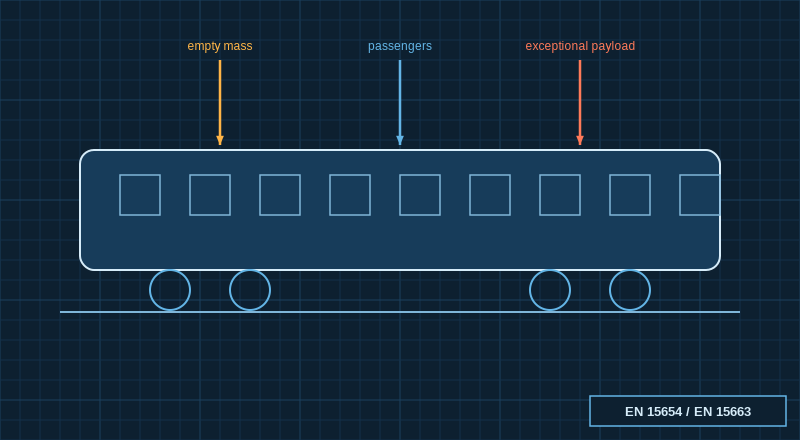
Load conditions
The starting point is the design mass of the vehicle in working order. It includes the complete vehicle with fluids, a share of supplies and consumables, such as sand, water and fuel, and the operating staff. The shares to be considered are set by the standard and depend on the type of vehicle.
The payload is added to this. The normal payload represents ordinary operation. The exceptional payload represents the most severe reasonably foreseeable condition, such as an extremely crowded passenger train. For passengers, the standard sets a conventional mass per person and different occupancy densities for seats and standing areas, depending on the type of service. For freight wagons, the payload is linked to the line category.
The three main combinations are therefore:
- design mass in working order
- design mass under normal payload
- design mass under exceptional payload
Design masses and operational masses
The standard distinguishes design masses, calculated on paper during development, from operational masses, which describe the vehicle in service. The former are used for sizing. The latter are used for operation, for example for the braked mass and for the axle load declared to the infrastructure manager.
Calculated and measured values are compared by weighing. The permitted tolerances between declared and measured mass depend on the edition of the standard and on the type of vehicle: check them in the text in force.
Where the masses are used
- Structural assessment of the carbody and bogie, with the loads of EN 12663
- Braking calculation and braked mass
- Running dynamics tests to EN 14363
- Suspension sizing and check of wheel load imbalance
- Compatibility with the infrastructure to EN 15528
- Register data and documentation for authorisation
Link with EN 15654 and EN 15528
EN 15654 deals with the measurement of vehicle masses: Part 1 covers weighing in production, with wheel and axle loads and the related uncertainties. It is the check that proves the built vehicle meets the masses declared according to EN 15663.
EN 15528 classifies lines into categories based on axle load and mass per metre of vehicle. The masses defined by EN 15663 are the input data for establishing which line categories the vehicle can run on. On this site you will find a free calculator for the EN 15528 line category and wheel loads.
Common mistakes
Typical mistakes are using the normal payload where the exceptional one is needed, forgetting supplies and staff in the mass in working order, estimating the centre of gravity too roughly and not updating the mass budget after modifications. Our studio can prepare the vehicle's reference mass budget to EN 15663, with axle and wheel loads.
Frequently asked questions
What is the mass in working order?
It is the mass of the vehicle ready for service, with fluids, a set share of supplies and the staff, but without payload. The exact shares depend on the type of vehicle and are set by the standard.
What is the difference between normal and exceptional payload?
The normal payload describes ordinary operation and is used, for example, for fatigue and comfort. The exceptional payload describes the most severe permitted condition and is used for strength assessments and for some braking cases.
Does EN 15663 also apply to freight wagons?
Yes. For wagons, the maximum payload depends on the line category according to EN 15528, and the reference masses follow the same definitions.
Is calculation enough, or does the vehicle also need to be weighed?
Calculation is needed in the design phase, but the declared masses must be confirmed by weighing the built vehicle according to EN 15654.
Summary for information only: the requirements are those of the official text of the standard in its current edition, available from the standards bodies. Ranieri — Servizi di ingegneria covers the mechanical side and does not carry out work reserved to members of a professional register.