
Scope
The standard applies to radial and thrust rolling bearings, ball and roller types, made from commonly used high-quality steels and under normal mounting conditions. The calculated life is a material fatigue life: it does not account for wear, corrosion, seizure or incorrect mounting.
The edition in use is the 2007 edition, which introduced the aISO factor in place of the old adjustment factors. For more advanced analyses, including internal load distribution and misalignment, there is the technical specification ISO/TS 16281.
Basic rating life L10
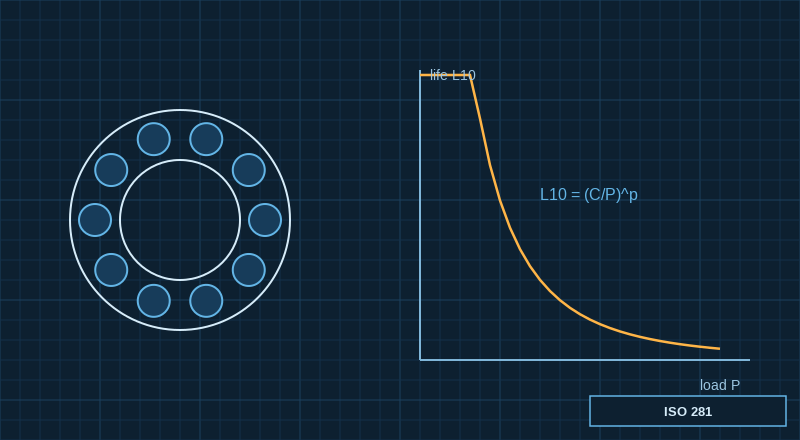
The basic rating life L10 is the number of revolutions, in millions, that 90% of a group of identical bearings reach or exceed before the first signs of fatigue appear. It is calculated with the formula L10 = (C/P)^p, where C is the basic dynamic load rating of the bearing and P the equivalent dynamic load.
The exponent p is 3 for ball bearings and 10/3 for roller bearings. To get the life in hours you divide by the speed: L10h = L10 · 1 000 000 / (60 · n), with n in revolutions per minute.
The equivalent load P combines the radial and axial components with the factors X and Y, which depend on the bearing type and on the ratio between axial and radial load. If the load varies over time, a mean equivalent load over the duty cycle is used.
Modified rating life Lnm
The modified rating life is Lnm = a1 · aISO · L10. The factor a1 adjusts for reliability: it is 1 for 90% and decreases if a higher reliability is required, for example 95% or 99%.
The factor aISO accounts for actual operating conditions. It depends on the ratio between the fatigue load limit Cu and the load P, on the contamination factor ec and on the viscosity ratio κ, that is the actual viscosity of the lubricant at operating temperature divided by the minimum required viscosity. The standard caps aISO at a maximum value, so excellent lubrication does not extend life indefinitely.
With clean oil and adequate viscosity aISO can be well above 1; with a lubricant that is too thin or contaminated it can drop below 0.5 and the actual life is reduced accordingly.
- Cu: fatigue load limit, given by the bearing manufacturer
- ec: contamination factor, from 1 for a very clean lubricant down to values close to zero for severe contamination
- κ: viscosity ratio, linked to the type of oil or grease, the temperature and the speed
Data you need
- Radial and axial loads on each support, obtained from the equilibrium of the shaft
- Rotational speed and duty cycle, if load and speed change
- Bearing type and designation, with C, C0 and Cu from the catalogue
- Lubricant, viscosity and operating temperature
- Expected cleanliness level and type of seals
- Required reliability and design life in hours
Common mistakes and related standards
The most common mistakes are using the radial load instead of the equivalent load, forgetting the induced axial loads in angular contact and tapered roller bearings, and calculating only L10 when lubrication and cleanliness are far from ideal. Another oversight is not checking static safety when the bearing operates stationary, oscillates or is subjected to shocks: in that case the basic static load rating of ISO 76 is what matters.
Ranieri — Servizi di ingegneria calculates ISO 281 bearing life with aISO and selects catalogue bearings for the supports of a shaft, and on the website you will find a free bearing life calculator.
Frequently asked questions
What does L10 mean?
It is the life, in millions of revolutions, that 90% of the bearings in a group reach or exceed. In other words, 10% of the bearings may show fatigue failure before that value.
Why is the exponent 3 for balls and 10/3 for rollers?
It derives from the different type of contact: point contact for balls and line contact for rollers. It is an experimental result adopted by the standard and used in all catalogues.
What is the difference between L10 and Lnm?
L10 considers only the load and the dynamic load rating. Lnm adds the required reliability through a1 and the actual conditions of lubrication, contamination and fatigue load limit through aISO.
Is the calculated life the actual life?
It is a statistical estimate of fatigue life. Wear, incorrect mounting, misalignment, corrosion or ineffective seals can reduce it considerably, and they are not covered by the calculation.
Summary for information only: the requirements are those of the official text of the standard in its current edition, available from the standards bodies. Ranieri — Servizi di ingegneria covers the mechanical side and does not carry out work reserved to members of a professional register.