
Scope
The standard covers the risks to consumer health linked to the design of the machine: microbiological, chemical and physical contamination of the product. It does not replace the assessment of risks to the operator, which follows EN ISO 12100.
It is applied together with the type-C standards for individual families of food machinery, which refer to EN 1672-2 for hygiene aspects. It has been updated over time: always check which edition is harmonised and which one you are applying.
The three areas of the machine
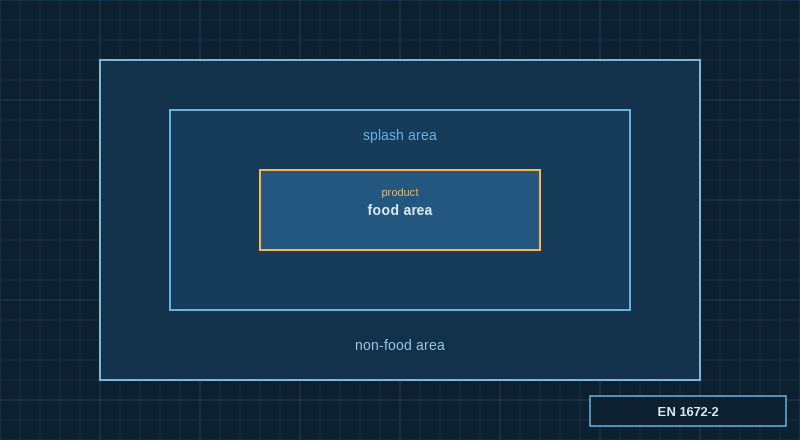
The first step is to divide the machine into areas, because the requirements vary greatly from one to another. The division should be made on the drawings and is best recorded in the technical file.
- Food area: surfaces in contact with the product, and surfaces from which the product or condensate can fall back into the product. This is where the requirements are strictest.
- Splash area: surfaces that the product can reach through splashing or spillage without returning to the main product.
- Non-food area: everything else, which must still be cleanable and must not encourage contamination of the other areas.
Main design requirements
- Materials: corrosion-resistant, non-toxic, suitable for food contact and compatible with detergents and disinfectants. For contact with the product, Regulation (EC) 1935/2004 and the specific rules for individual materials also apply.
- Surface finish: smooth, defect-free surfaces in the food area, with reference roughness values given in the standard; the permitted value depends on the area and the edition.
- Radii and corners: radiused internal corners and no sharp edges or closed corners where dirt collects.
- Joints: continuous, finished welds instead of overlaps, crevices and unsealed metal-to-metal joints.
- Fasteners: exposed screws and nuts avoided in the food area, or replaced with cleanable solutions.
- Cleanability: surfaces accessible for cleaning and inspection, tool-free dismantling where needed, no closed cavities.
- Drainage: sloping surfaces and low points with outlets, so that water and product do not stagnate.
The relationship with EN ISO 14159
EN ISO 14159 deals with hygiene requirements for the design of machinery in general. EN 1672-2 applies them to food machinery with more specific guidance. In practice they are used together, often alongside the hygienic design guidelines of industry associations.
Documents and common mistakes
To demonstrate conformity you need the division into areas, the list of materials with declarations of suitability for food contact, the finishes specified on the drawings, the cleaning and dismantling instructions and a check of the construction details against the standard. The studio designs custom food machinery for producers and can check the hygiene requirements of a design to EN 1672-2.
The most common mistakes are open or drilled hollow sections in the food area, spot welds between overlapping sheets, exposed threads above the product, horizontal surfaces without a slope and seals unsuitable for food or for detergents.
Frequently asked questions
What is the difference between the food area and the splash area?
In the food area the surfaces touch the product or can let something fall back into it. In the splash area the product can reach the surfaces but does not return to the main flow. The requirements for the former are stricter.
Is a stainless steel machine automatically compliant with EN 1672-2?
No. The material is only one of the requirements. Surface finish, radii, joints, fasteners, cleanability and drainage also matter: a stainless steel machine with crevices and cavities is not hygienic.
Is EN 1672-2 mandatory?
Standards are voluntary, but food machinery must meet the hygiene requirements of machinery legislation. Applying the harmonised standard is the most direct way to show this.
Is EN 1672-2 enough for food contact?
No. It covers the hygienic design of the machine. The suitability of materials for food contact follows Regulation (EC) 1935/2004 and the specific rules for each material.
Summary for information only: the requirements are those of the official text of the standard in its current edition, available from the standards bodies. Ranieri — Servizi di ingegneria covers the mechanical side and does not carry out work reserved to members of a professional register.