
Scope and role among the standards
It is a type-A standard: it applies to all machinery and defines concepts, terminology and method. Type-B standards deal with cross-cutting aspects, such as control systems or safety distances, while type-C standards cover individual families of machines.
If a type-C standard exists for your machine, it takes precedence for the hazards it covers. EN ISO 12100 nevertheless remains the reference for the method and for the hazards that the type-C standard does not cover.
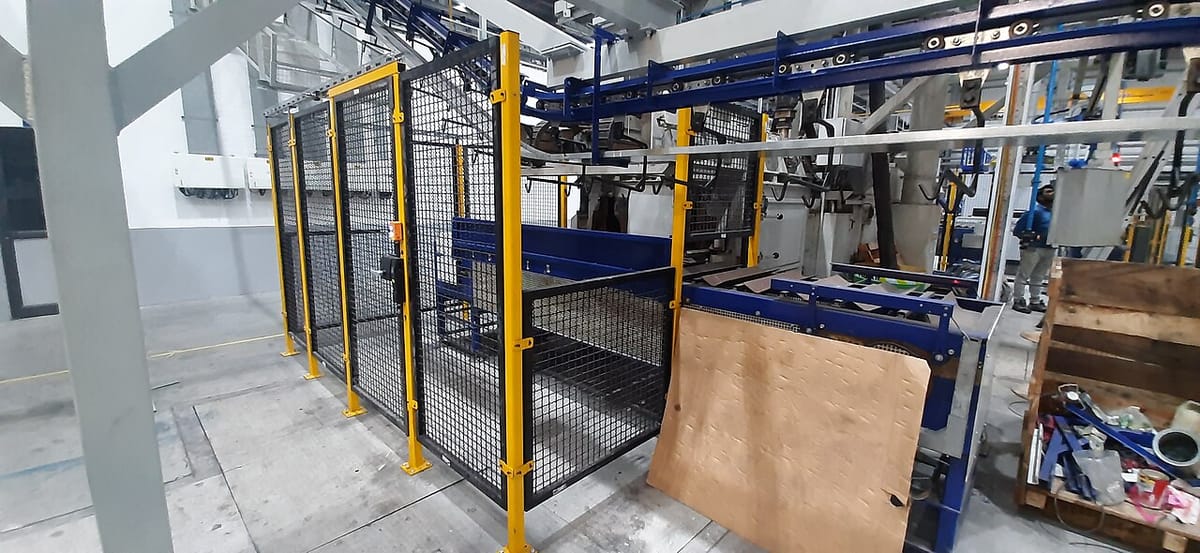
The risk assessment process
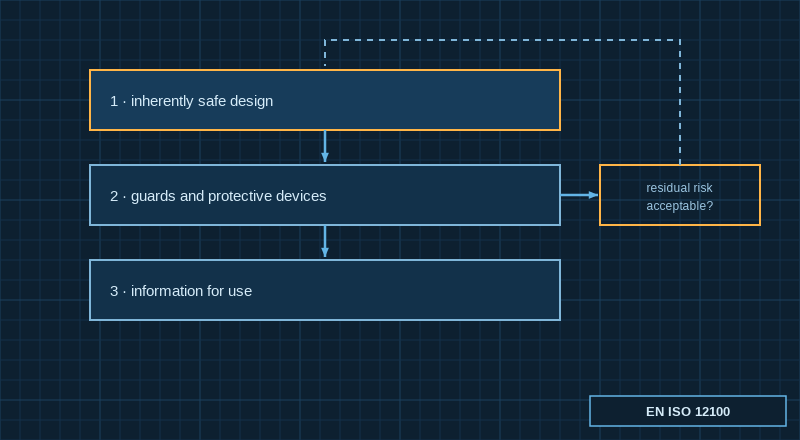
The standard describes an iterative process. You start from the limits of the machine, identify the hazards, estimate and evaluate the risk, then decide whether risk reduction measures are needed and repeat the cycle until the residual risk is acceptable.
- Limits of the machine: intended use and reasonably foreseeable misuse, space limits, time limits such as the service life of components, operator profile.
- Hazard identification across all life-cycle phases: transport, installation, commissioning, production, setting, cleaning, maintenance, decommissioning.
- Risk estimation: severity of the possible harm and probability of it occurring, taking into account exposure, probability of the hazardous event and the possibility of avoiding or limiting the harm.
- Risk evaluation: comparison with the safety objectives and decision on whether further risk reduction is needed.
The three-step method
Risk reduction follows a precise order. You cannot move on to the next step if an earlier step is still practicable.
A typical mistake is relying on warnings in the manual for risks that could have been eliminated by design.
- Step one: inherently safe design, i.e. eliminating the hazard or reducing it by choosing suitable geometries, forces, speeds and materials.
- Step two: guards, protective devices and complementary protective measures, such as emergency stop.
- Step three: information for use, i.e. signs, warnings and instructions on the residual risk.
EN ISO 12100 and the Machinery Regulation (EU) 2023/1230
Regulation (EU) 2023/1230 replaces Directive 2006/42/EC and applies from 20 January 2027. Under the Regulation too, risk assessment remains an obligation of the manufacturer and part of the technical file.
Harmonised standards give a presumption of conformity with the requirements they cover. Always check which edition is cited in the Official Journal for the act you are applying, because the list is updated over time.
Documents to prepare
The standard requires the assessment to be documented so that it can be retraced. In practice the document contains the limits of the machine, the list of hazards by life-cycle phase, the risk estimate before and after the measures, the measures adopted with the step they belong to, the standards applied and the residual risk to be stated in the instructions.
The studio can draw up the risk assessment of a simple machine to EN ISO 12100, starting from the drawings and the description of how it works.
Related standards
For practical application, ISO/TR 14121-2 is often used, as it gives examples of estimation methods. Other related standards are EN ISO 13849-1 for control systems, EN ISO 13857 for safety distances, EN ISO 14120 for guards, EN ISO 13850 for emergency stop and EN ISO 14122 for means of access.
Frequently asked questions
Is EN ISO 12100 mandatory?
Standards are voluntary. Risk assessment, however, is mandatory for the manufacturer, and following EN ISO 12100 as a harmonised standard is the most direct way to show it has been carried out correctly.
What is the difference between risk assessment and risk analysis?
In the standard, risk analysis comprises the limits of the machine, hazard identification and risk estimation. Risk assessment adds risk evaluation, i.e. the decision on whether the risk is acceptable.
Does EN ISO 12100 replace EN ISO 14121-1?
Yes. The 2010 edition brought together the old EN ISO 12100-1, EN ISO 12100-2 and EN ISO 14121-1 in a single document. Part 2 of 14121 remained as a technical report with practical examples.
Does a modified machine have to be reassessed?
Yes, if the modification introduces new hazards or increases existing risks. Under Regulation 2023/1230, whoever carries out a substantial modification takes on the manufacturer's obligations for the part concerned.
Summary for information only: the requirements are those of the official text of the standard in its current edition, available from the standards bodies. Ranieri — Servizi di ingegneria covers the mechanical side and does not carry out work reserved to members of a professional register.