
Scope
The standard covers non-fixed attachments that are not a permanent part of the crane or hoist. These include:
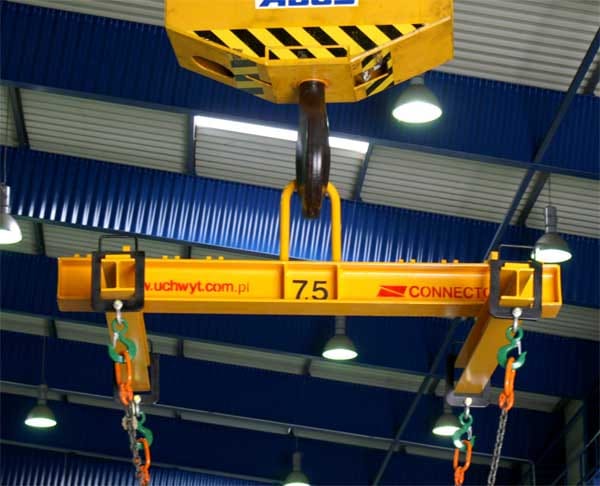
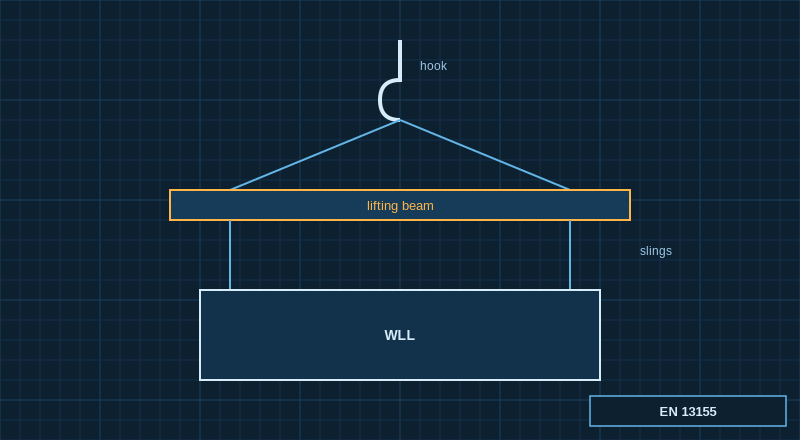
- lifting beams and spreader beams, including frames with several lifting points
- plate clamps and clamps gripping by friction or by form
- C-hooks for coils and similar loads
- lifting forks for palletised loads
- magnetic devices, permanent, electromagnetic or battery-fed
- vacuum lifters, with pump or ejector
What is excluded
Slinging accessories such as wire rope, chain or textile slings, shackles and hooks have their own product standards. Attachments for lifting persons and those that are an integral part of the machine are also excluded. If the attachment has its own drives, the requirements of EN 13155 are added to the general safety requirements for machinery.
Main requirements
The structure must be designed for the rated capacity, including the dynamic effects of lifting and the permitted gripping configurations. The standard requires a static strength check and, when the attachment works through many cycles, a fatigue check as well. Depending on the edition, the structural calculation may refer to the methods of the EN 13001 series.
Each type of attachment has specific requirements. For clamps, the margin on the gripping force and the range of load thicknesses matter. For magnets and vacuum lifters, what matters is the pull-off force under the declared conditions, the warnings for loss of power or vacuum and the energy reserve that holds the load for a minimum time. For lifting beams, stability, the position of the centre of gravity and the strength of the lifting eyes matter.
Conformity is also demonstrated by testing. Each unit, or the prototype depending on the case, is subjected to a static test with a load equal to the rated capacity multiplied by a coefficient. The coefficient depends on the type of attachment and the edition of the standard: read it in the text in force and record it in the test report.
Marking and instructions
The attachment must bear, legibly and durably, at least the manufacturer's identification, the model or serial number, the rated capacity and its own mass when significant. Remember that the mass of the attachment adds to the load and reduces the usable capacity of the crane.
The instructions for use must explain how to attach and sling, which loads are permitted, the temperature, surface or thickness limits, the checks before use and the periodic inspections.
Data and documents to prepare
- Rated capacity and type of loads, with dimensions, centre of gravity and material
- Planned gripping configurations and sling angles
- Expected number of cycles over the life of the attachment
- Drawings and bill of materials, with material certificates for load-bearing parts
- Structural and connection calculation report
- Static test report and, where required, dynamic test report
- Technical file, EC declaration of conformity and instructions
Common mistakes and related standards
Recurring mistakes are a load centre of gravity off the axis of the lifting beam, lifting eyes checked only in simple tension, welds without detail checks and generic instructions. Our studio can carry out the structural check of a lifting beam or a clamp to EN 13155 and prepare the calculation report.
Related standards: EN ISO 12100 for risk assessment, EN 1993-1-1 and EN 1993-1-8 for steel members and connections, EN 13414 for wire rope slings, EN 818 for chains, EN 1492 for textile slings, EN 13889 for shackles. The legal reference is the Machinery Directive 2006/42/EC, replaced by Regulation (EU) 2023/1230 from 20 January 2027.
Frequently asked questions
Is a lifting beam a machine or a lifting accessory?
For the purposes of the Machinery Directive, a lifting beam without drives is a lifting accessory. CE marking is still required, with a technical file and the manufacturer's declaration of conformity.
Who has to carry out the static test?
It is the manufacturer's responsibility before putting into service. The test coefficient depends on the type of attachment and is set by the standard; the result must be documented.
If I modify an existing attachment, do I have to repeat the checks?
If the modification changes the capacity, geometry or gripping method, yes: whoever modifies it takes on the manufacturer's obligations for the parts concerned.
Does EN 13155 also apply to crane hooks?
No. The hook is part of the lifting appliance and is covered by other standards. EN 13155 covers what is hung on the hook.
Summary for information only: the requirements are those of the official text of the standard in its current edition, available from the standards bodies. Ranieri — Servizi di ingegneria covers the mechanical side and does not carry out work reserved to members of a professional register.